Paper Wasps
in Wisconsin
Long-legged, slender wasps that build open, umbrella-shaped paper nests under eaves, deck rails, and porch ceilings. Far less aggressive than yellow jackets, but they will defend a nest that gets bumped or brushed against — and they love to nest right where people walk and sit.
What They Do for Wisconsin
Paper wasps are beneficial predators. Workers hunt caterpillars, beetle larvae, and flies to feed their larvae — excellent free garden pest control. They are much less aggressive than yellow jackets and usually only sting when their nest is directly threatened. The problem is location: they favor eaves, deck railings, porch ceilings, and play-set crossbeams — exactly where arms, heads, and cleaning brushes end up all summer.
What They Do in the Winter
Paper wasp colonies are annual. The colony dies in fall, and only fertilized queens survive the winter tucked into protected crevices. Each spring a lone queen starts a brand-new nest from scratch, and old nests are never reused. Overwintering queens often hibernate in small groups in attics and wall voids.
- Only fertilized queens overwinter — under bark, in attics, or in wall voids.
- The rest of the colony dies at first hard frost.
- Each spring a single queen starts a new nest in a new spot.
- Old umbrella nests are abandoned and are not reused the following year.
Nesting
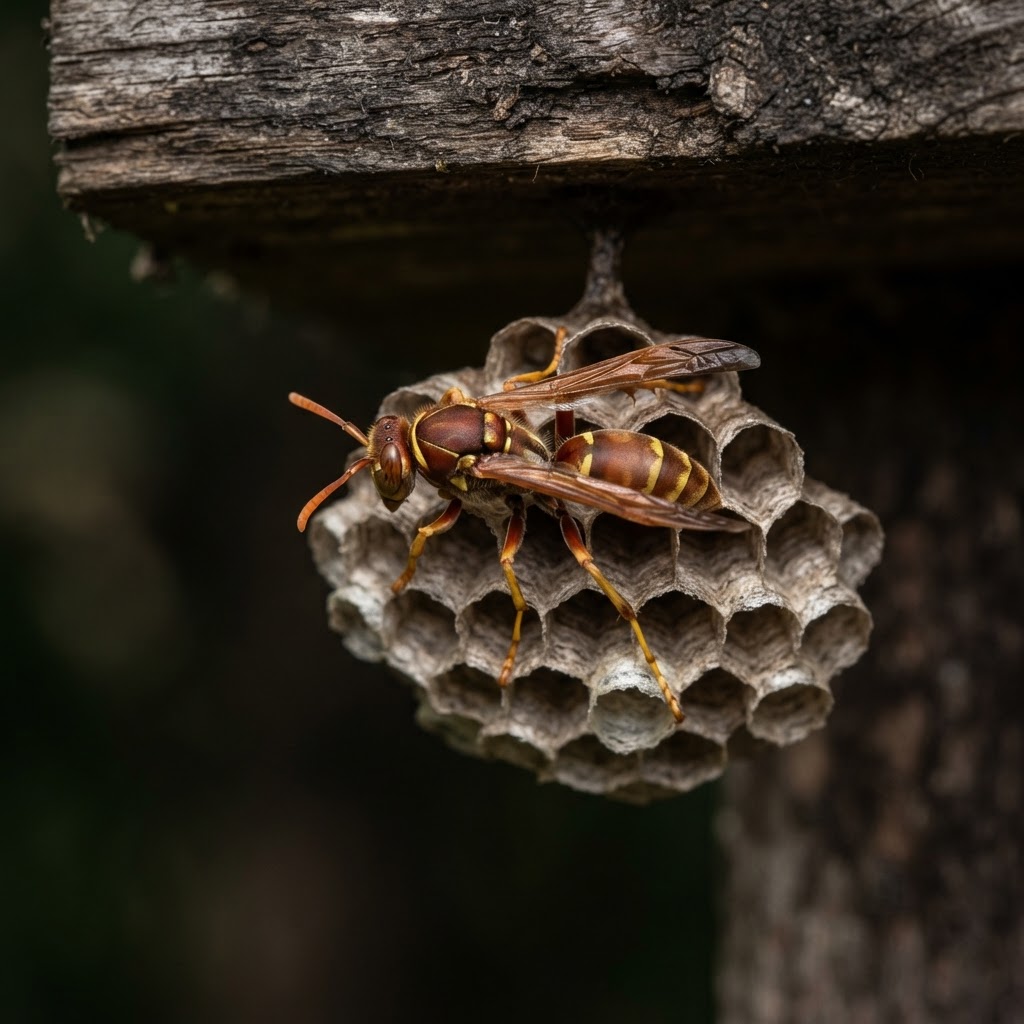
Paper wasps build a single, open, umbrella-shaped paper comb with the cells facing downward — no outer envelope, so you can see right into the cells. Nests hang by a short stalk under eaves, deck rails, porch ceilings, and branches. Colonies are small, usually 20–100 workers.
Diet
Paper wasps are hunters. Workers chew up caterpillars and other soft-bodied insects to feed the larvae, and adults drink nectar for energy. They are welcome allies in a vegetable garden — until they nest over your back door.
- Caterpillars (a favorite — great for gardens)
- Beetle larvae and flies
- Other soft-bodied insects
- Nectar and tree sap (adult energy)
Fast Facts
Paper wasps fly with their long legs trailing below them — a quick way to tell them from yellow jackets in the air.
Unlike yellow jackets and hornets, their nest has no paper envelope — you can see the exposed comb cells.
They are much calmer than yellow jackets but will defend a nest that is bumped, brushed, or sprayed with a hose.
Fall queens often hibernate together in attics and wall voids, then emerge indoors on warm winter days.
A nest away from walkways is a free caterpillar-control service — consider leaving it alone.
Like other wasps, paper wasps have smooth stingers and can sting more than once.
When to Call Mid State
Paper Wasps nests near your home, deck, or play areas are a real safety risk — they can sting repeatedly and swarm when disturbed. Don't treat a large nest yourself. Our team removes them safely and treats the area to prevent rebuilding.